Featured

The Aepyornis

What is an Aepyornis?

“When they found an Aepyornis with a thigh a yard long, they thought they had reached the top of the scale, and called him Aepyornis maximus. Then someone turned up another thigh-bone four feet six or more, and that they called Aepyornis titan. Then your vastus was found.”

— H. G. Wells
An unnamed artist’s interpretation of an Aepyornis (Dinopedia).

The Bird

The Aepyornis maximus was the largest bird of its kind ever discovered (Uchytel). Being a ratite bird, it belonged to the same family as the emu and ostrich, and was native to Madagascar before going extinct hundreds of years ago (Dictionary.com). These creatures, also known as elephant birds, are estimated to have died out sometime during the 1800s (Uchytel).

The Egg

An Aepyornis egg is approximately “over 100 times the average size of a chicken egg” (Wordless Tech).

Aepyornis eggs were often more than one metre in circumference, and more than thirty-four centimetres in length, making them “the largest type of bird egg ever found” (Uchytel).

The Largest Genus

New Aepyornis bones are still surfacing to this day, giving palaeontologists greater insights into the vastness of the creature’s kind (Quenqua). Even in the last few years, researchers have found evidence of Aepyornis birds with estimated weights of over seventeen thousand pounds (Quenqua). The fact that scientists are constantly finding new information on these birds, and were also finding new information back in the days of H. G. Wells, gave the writer a perfect opportunity to imagine an even larger version of this species, and what could happen if it were to co-exist with a human.

For more information on the discovery of the largest Aepyornis on record, visit “The Elephant Bird Regains Its Title as the Largest Bird That Ever Lived.”

Alixx Hettinga | Dec. 1, 2019

An artist depicts their interpretation of the Aepyornis maximus in its prime (Uchytel).

Works Cited

Dictionary.com. “Aepyornis.” Dictionary.com, https://www.dictionary.com/browse/aepyornis.

Dinopedia. “Aepyornis.” Dinopedia, https://dinopedia.fandom.com/wiki/Aepyornis.

Quenqua, Douglas. “The Elephant Bird Regains Its Title as the Largest Bird That Ever Lived.” The New York Times, 26 Sept. 2018, https://www.nytimes.com/2018/09/26/science/largest-elephant-bird.html.

Uchytel, Roman. “Aepyornis Maximus.” Prehistoric Fauna – Extinct Animals Images – Reconstructions, https://prehistoric-fauna.com/Aepyornis-maximus.

Wells, Herbert George. “Aepyornis Island.” 1894. Literature Network, http://www.online-literature.com/wellshg/1/.

Wordless Tech. “Giant Elephant Bird Egg up for Auction.” WordlessTech, 29 Mar. 2013, https://wordlesstech.com/giant-elephant-bird-egg-up-for-auction/.

“Aepyornis Island” in the Realm of Science Fiction

“A science fiction story is a story built around human beings, with a human problem and a human solution, which would not have happened at all without its scientific content.”

— Theodore Sturgeon

Why “Aepyornis Island” Constitutes Science Fiction

General Science Fiction

While many definitions of science fiction exist, Theodore Sturgeon’s is among the most popular. He claims that the genre is characterized by stories that are centred around humans and their actions, but their plots are driven by the scientific elements present in each narrative (Anders).

H. G. Wells’s short story “Aepyornis Island” fits this description perfectly. The plot follows Butcher, a man who was stranded on an island with a newly hatched bird, whose species had been extinct for three hundred years. The creature emerged from an egg that Butcher had uncovered in a mineral-rich swamp, which he says kept the egg from rotting.

Without this scientific anomaly, the story would merely be about a castaway who survived by himself on the shore of an uncharted island for four years. Such a plot would not be considered science fiction by any means. The actions Butcher takes as a result of the Aepyornis’s scientifically rationalized preservation, emergence from its egg and growth as a living creature are what categorize this work as science fiction.

Hard Science Fiction

“Here was I hatching out the eggs of the biggest of all extinct birds, in a little canoe in the midst of the Indian Ocean.”

H. G. Wells

As previously mentioned, Wells justifies the conservation of the egg, as well as the survival of the embryo within it for hundreds of years, by using the scientific principles of preservation. The protagonist Butcher marvels at the properties of the swamp in which the Aepyornis eggs are found, saying, “And somehow there’s something in the water that keeps things from decaying. Like creosote it smells” (Wells).

This quote exemplifies how Wells attempts to explain the phenomenon of the preserved life within the egg, without mentioning the exact minerals or chemistry of the matter. This is due to the fact that such a natural preservation of life for hundreds of years is undiscovered in the reality Wells and his readers know.

Wells hints to the possibility of creosote being involved, which is a tar-like substance “used mainly as a preservative for wood and as an antiseptic” (Dictionary.com). Mentioning a substance known for preservation provides his story with more validity, as many of his readers would recognize creosote’s ability to keep materials from rotting, and could thus imagine it’s potential to possibly preserve not only matter, but also life.

Wells’s application of logic to the anomaly he writes about helps classify his short story as hard, rather than soft, science fiction. Hard science fiction often involves physics or chemistry, and is based on logic and scientific accuracy, so readers can comprehend the circumstances described as possible. In contrast, soft science fiction encompasses the social sciences, and writers are less concerned with the realistic plausibility of the scientific situations they create.

Comparing Cognitive Estrangement in Similar Science Fiction Works

Science fiction is “a literary genre whose necessary and sufficient conditions are the presence and interaction of estrangement and cognition, and whose main formal device is an imaginative framework alternative to the author’s empirical environment.'”

— DARKO SUVIN.

Darko Suvin theorizes that science fiction goes beyond simply including a scientific element that drives the story forward. He believes there must be something peculiar about the story world, which causes a reader to contemplate how and why their own world does not entirely line up with the one they are reading about (Anders).

This peculiarity can be subtle or alarming. Either way, the presence of this strange existent, which sets a narrative’s environment apart from reality, creates cognitive estrangement, meaning it causes readers to ponder their own lives and worlds in comparison (Oxford Reference).

H. G. Wells’s The Time Machine is an example of a text that demonstrates an obvious deviance from the world readers know, because it involves a man being able to travel so far into the future that the human race has diverged into two subspecies (Wells 148). This creates cognitive estrangement, because the scientific element that sets the story apart from reality is so stark that readers are forced to consider how the classes people create can be so divisive that people groups may eventually evolve to be separated biological and intellectually from each other.

In contrast, Mary Shelley’s Frankenstein bears more resemblance to “Aepyornis Island,” since the scientific peculiarity is subtler, as the tale takes place in a world that readers recognize, as opposed to a future time period they have yet to experience. The cognitive estrangement effected in Frankenstein is due to one major scientific discovery its protagonist makes, rather than the discovery of a new world (Shelley 91). The case is the same with “Aepyornis Island.”

For example, Cory Gross’s review of “Aepyornis Island” suggests that readers of the short story may read of the circumstance of the bird’s unlikely birth and wonder why the species went extinct in the first place, since many researchers theorize that human consumption of Aepyornis eggs caused their demise (Gross). As such, readers may consider their impact on the world, and how they themselves would react if, like Butcher, they were faced with the opportunity to give a lost species another chance at life.

Alixx Hettinga | Dec. 3, 2019

“I put AEPYORNIS ISLAND all around the place very nearly, in big letters, like what you see done with coloured stones at railway stations in the old country, and mathematical calculations and drawings of various sorts. And I used to lie watching the blessed bird stalking round and growing, growing.”

— H. G. Wells

Works Cited

Anders, Charlie Jane. “How Many Definitions of Science Fiction Are There?” Gizmodo, 27 Aug. 2010, https://io9.gizmodo.com/how-many-definitions-of-science-fiction-are-there-5622186.

Dictionary.com. “Creosote.” Dictionary.com, https://www.dictionary.com/browse/creosote

Gross, Cory. “Æpyornis Island by H.G. Wells.” Voyages Extraordinaires, 26 June 2019, https://voyagesextraordinaires.blogspot.com/2019/06/pyornis-island-by-hg-wells.html.

Oxford Reference. “Cognitive Estrangement.” Oxford Reference, 31 Oct. 2019, https://www.oxfordreference.com/view/10.1093/oi/authority.20110803095622261.

Shelley, Mary Wollstonecraft. Frankenstein. 1819. Open Road Media Integrated Media, 2014.

Wells, Herbert George. “Aepyornis Island.” 1894. Literature Network, http://www.online-literature.com/wellshg/1/.

Wells, Herbert George. The Time Machine. 1895. Open Road Integrated Media, 2014.

Short Story Summary

Aepyornis Island Summary

“With that tragedy loneliness came upon me like a curse. Good Lord! you can’t imagine how I missed that bird.”

– H. G. Wells

H. G. Wells’s “Aepyornis Island” begins with a narrator, who sits across from an explorer with a scar on his face and a story to share. The scarred man strikes up a conversation, paying little attention to the level of interest his audience of one may have. The storyteller exposes himself to be Butcher, an explorer famously known for suing his employer for the four years’ worth of salary he felt he was owed for the time he spent as a castaway while on assignment.

Upon revealing this, Butcher gains his listener’s attention immediately, and he begins his tale of those years he spent stranded on that island off of Madagascar, where he coexisted with a bird whose species had been extinct for hundreds of years.

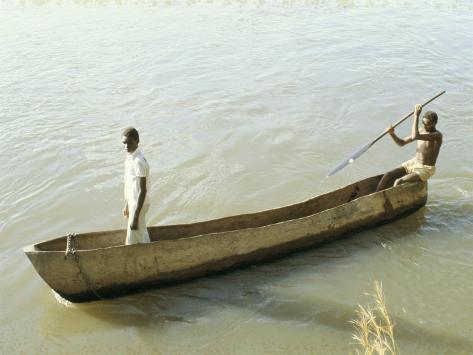
Two men maneuver a dugout canoe (All Posters).

The swamp he had originally travelled to in Madagascar, so thick and rich with untold minerals, prevented the decay of matter. As such, Butcher and his two guides, natives to the land, uncovered four fresh and fully intact Aepyornis eggs, along with the bones of perhaps the very creature that laid them.

One of the guides, upon being bitten by a centipede, dropped and destroyed the fourth egg, which had taken hours to dig up without damaging it. Angered at the loss, Butcher struck the man, instigating a miniature mutiny. The two guides took the canoe, the remaining eggs, the bones they had found and a portion of the food, and they set off to claim their riches without Butcher.

He shot one of the men down and battled the ocean waves to swim out to the boat. Upon reaching it, he found that the other guide had died from his centipede sting. By this time, Butcher had drifted far from the shore of Madagascar, and was without paddles or a way to return to land.

After ten days of drifting, a starving Butcher broke one of the Aepyornis eggs and devoured it. When he opened the second egg a few days later, he discovered a developing embryo. Though the eggs had been resting in that swamp for an estimated three hundred years, the minerals had kept them from rotting, and now the embryos within were growing.

An artist depicts the estimated difference between an Aepyornis maximus and a human being (Ben).

When Butcher finally washed up on an indeterminate reef, a storm raged around him on the shore, and he slept with the remaining egg for comfort. When the torrents ceased and he could finally rest, a baby Aepyornis hatched from the final egg.

The creature was an amiable chick, and the man found the hatchling to be interesting company. Years passed and no boats came to rescue them, so they made a home of that isolated place, which Butcher named Aepyornis Island.

As they entered the third year of their exile, the chick had grown into a full-fledged bird, and when food became scarce, the man and beast began to fight each other for what they could scavenge. After receiving his facial scar from the animal, Butcher swam across the island’s lagoon to distance himself from the Aepyornis, hoping that after some time had passed, the bird would realize its errors and they could be friendly again.

An arial view reveals the complexity of the island of Madagascar (Wallpapers High Quality).

This was not the case. After their separation, they remained at war with each other for food and resources. After much time had passed in this way, the explorer fashioned a rope from seaweed and fishing nets, and he tied a few stones to the end to create a makeshift bola. With this craft, he knocked his adversary to the ground. Much to his continued horror, he then decapitated the fallen bird with his own knife.

Butcher could not bring himself to eat the creature, so allowed the lagoon’s fish to instead pick its bones clean. When bones were all that remained, he was rescued by a touring yachter. Butcher sold the Aepyornis’s bones, and later it was discovered that the bird was larger than any of its kind before. As such, it earned the title of Aepyornis vastus, the largest Aepyornis known to man, and it had lived and died three hundred years after the extinction of its species.

Alixx Hettinga | Nov. 30, 2019

Works Cited

All Posters. Dugout Canoe on the River Nile. http://imgc.allpostersimages.com/images/P-473-488-90/21/2161/5AECD00Z/posters/jack-jackson-dug-out-canoe-on-the-river-nile-at-mongala-southern-area-sudan-africa.jpg.

Ben. “Aepyornis.” Its Nature, http://itsnature.org/rip/aepyornis/.

Wallpapers High Quality. “Madagascar Island.” Wallpapers High Quality, 1 Mar. 2018, http://yesofcorsa.com/madagascar-island/.

Wells, Herbert George. “Aepyornis Island.” 1894. Literature Network, http://www.online-literature.com/wellshg/1/.

Design a site like this with WordPress.com
Get started